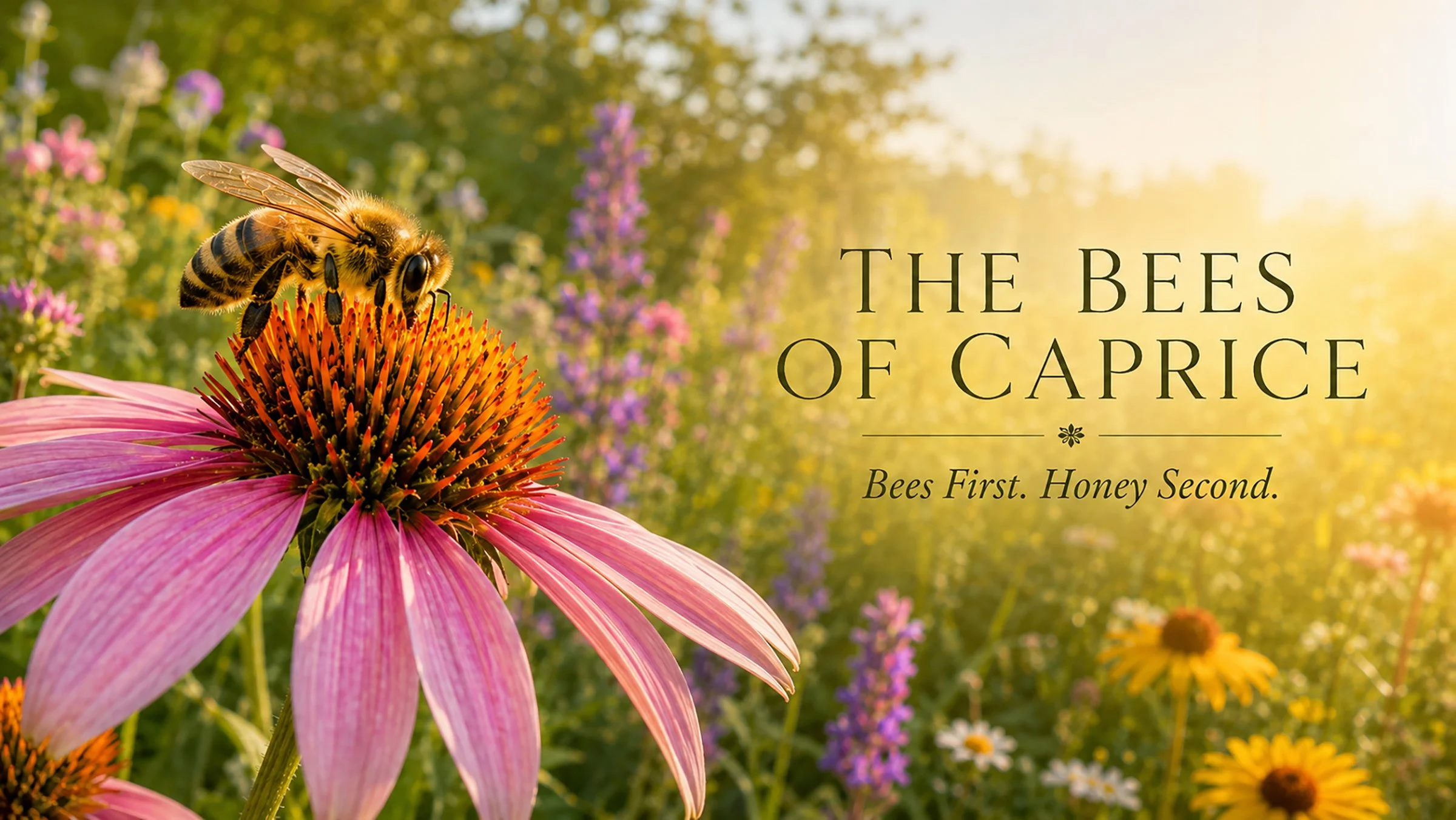
The Bees of Caprice
Bees First. Honey Second.
At Caprice, we are learning more every season about what happens when a garden becomes more than a place where things are grown.
It becomes habitat and a refuge.
It becomes food, water, shelter and connection for far more lives than our own.
The Bees of Caprice is our next step in that journey.
We are preparing to welcome our first managed honey bee colony to Caprice, but we are approaching beekeeping a little differently.
Our goal is not to see how much honey we can produce. Our goal is to discover how much we can give back.
A Bee-First Approach to Beekeeping
Our guiding philosophy is simple:
Bees first. Honey second.
The colony's health, food stores and long-term survival will always take priority over harvesting honey.
We want to provide the bees with a safe home, clean water, abundant seasonal forage, responsible care and a landscape increasingly designed around the needs of pollinators.
If the colony eventually produces more honey than it needs, we may accept a small portion of that abundance.
If the bees need it, it stays with the bees.
Some years that may mean beautiful jars of honey from Caprice.
Other years it may mean none at all.
Either outcome will be a successful year if the colony is healthy, thriving and living its best life as well.
The Journey Begins Before the Bees Arrive
The Bees of Caprice will not begin when a hive is delivered.
It has already begun. We already have a healthy thriving oasis here including many other pollinators. We have made our plans, learned what we need to do moving forward and are at a point where we are ready to start sharing this Bees of Caprice journey with others in the Caprician New Earth Movement and Beyond.
We will document the process of preparing the land and ourselves for responsible beekeeping, including learning about honey bee biology, selecting an appropriate hive location, providing dependable water, improving seasonal forage and understanding the health challenges faced by modern honey bee colonies.
We will also continue creating habitat for the native bees, butterflies, moths and other pollinators already living here.
Honey bees will become part of the larger ecosystem at Caprice.
Learning Alongside the Colony
We are beginning this journey as students.
Rather than pretending to know everything before we begin, we want to share the learning process honestly with all of you as we go along.
We will document our first hive setup, our first colony, our first inspections, the plants the bees visit throughout the seasons, changes within the colony, responsible pest and disease management, preparation for winter and eventually, if the colony has true surplus, our first small honey harvest.
Along the way, we hope to answer questions many beginning beekeepers have.
What does a healthy colony actually need?
How much honey should remain with the bees?
What plants provide food at different times of year?
How can a garden support honey bees without neglecting native pollinators?
How can we observe and photograph bees without constantly disturbing them?
And perhaps most importantly:
How to have a relationship with bees that is one of reciprocity rather than extraction?
That is the question at the heart of this project.
More Than a Beehive
The Bees of Caprice is part of a much larger awakening taking place here.
Through Caprician New Earth Gardening, we are working toward a landscape where food production, wildlife habitat, pollinator support, water stewardship, soil regeneration, native plants, completely chemical-free growing practices, responsible lighting and gradual self-reliance work together as one interconnected system.
Nothing exists in isolation.
The garden feeds us.
The flowers feed the pollinators.
The pollinators help create the food.
The soil supports the plants.
Water supports everything.
Wildlife becomes part of the greater garden rather than something pushed beyond the property's borders.
And humans become participants in the system instead of simply consumers of it.
The new bees will become another part of that whole.
The New Earth Gardening Conversations
The lessons we learn at Caprice extend beyond our own property.
As part of our developing New Earth Gardening virtual meetings, workshops and summits, we are bringing together people with practical knowledge across many parts of the living world.
These conversations explore subjects such as native plants, pollinator habitat, butterflies, responsible beekeeping, seasonal food gardening, wildlife stewardship, dark-sky-friendly landscapes, sustainability, observation of the natural world and ways children and families can reconnect with nature.
Our goal is not to create a room full of people who all know the same things.
It is to connect people who each understand a different piece of the whole.
And then learn from one another.
We Are Seeking a Founding Hive Partner
The Bees of Caprice is currently seeking an aligned beekeeping partner to help us establish our first managed colony responsibly.
We are especially interested in working with a company that believes the future of beekeeping should include education, responsible colony stewardship, pollinator protection and a deeper understanding of the relationship between bees and the landscapes surrounding them.
An ideal partnership could include our first complete hive system, beginning beekeeping education, equipment and ongoing guidance as we learn.
In return, we plan to document the experience through nature and wildlife photography, articles, video, social media, educational content, virtual programs and the continuing story of Caprice.
We would also welcome the opportunity to include a representative or experienced beekeeper from our hive partner in a future New Earth Gardening virtual meeting or summit, giving participants an opportunity to learn directly from someone who understands both the bees and the equipment used to care for them.
This is not intended to be a short product review.
It is intended to become a story measured in seasons.
What Can We Give the Bees?
There will probably come a day when we stand beside our hive with an empty jar.
But the question we want to ask first will not be:
How much honey can we take?
It will be:
Do the bees have everything they need?
Only after we can answer yes does the jar matter.
That is the relationship we hope to build at Caprice.
Bees first. Honey second.
And the journey begins now.